


You've felt it before. You pull on a cheap tee and something's off, the fabric feels thin, scratchy, slightly wrong against your skin. Then you try one that costs three or four times more, and the difference is immediate. But why expensive t-shirts feel better isn't just about price. It comes down to specific, measurable choices made at every stage of production, from the cotton field to the final stitch.
The gap between a $10 tee and a $60 one lives in the fiber length, the yarn twist, the fabric weight, the dyeing process, the cut, and the finishing. Each of these factors affects how a shirt drapes, breathes, softens over time, and holds its shape after dozens of washes. None of it is accidental. And once you understand what's actually happening at the material level, you stop guessing and start choosing with clarity.
At SÖMNAD, we build our entire line around this principle. Our relaxed tee uses 300g Supima cotton, one of the longest-staple, most durable cotton fibers grown, because we believe the quality should be obvious the second you put it on, no logo required. This article breaks down exactly what separates a premium t-shirt from a forgettable one: the fabric composition, the construction methods, the fit engineering, and the finish details that your skin notices even when your eyes don't.
What people mean by "feels better" in a T-shirt
When people say a shirt "feels better," they're describing a cluster of physical sensations that happen the moment fabric contacts skin. Softness is usually the first thing you notice, but it's only one part of a larger experience. A shirt that genuinely feels better also sits correctly on your shoulders, drapes without pulling or twisting, and doesn't create the low-grade irritation that makes you want to change outfits by noon.
The physical sensations that register first
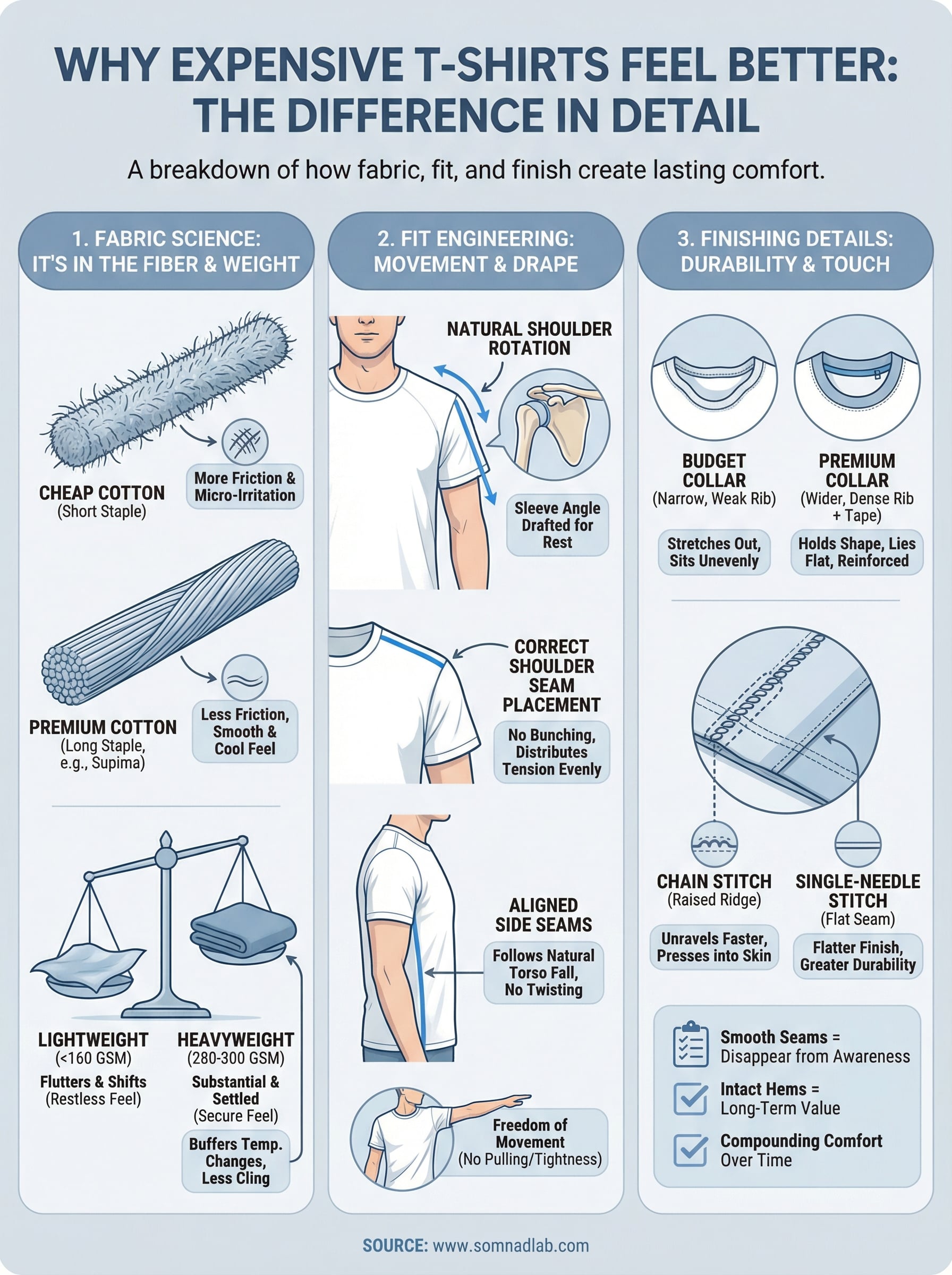
Your skin picks up texture before your brain consciously processes it. When a fabric has short, coarse fibers, they stick up from the yarn surface and create friction against your skin. That friction triggers a mild but constant sensory response, not sharp enough to call pain, but enough to keep you aware of the shirt all day. Premium fabrics use longer fibers that lie flat against the yarn structure, reducing surface irregularity and creating the smooth, almost cool initial contact that makes you want to keep the shirt on.
Weight matters in a different way than most people expect. A heavier fabric, like a 300g cotton, doesn't feel heavy on your body. It feels substantial, settled, and secure. Lightweight fabrics flutter and shift with every movement, which creates a restlessness you may not consciously identify but definitely feel by the end of a full day.
The reason why expensive t-shirts feel better comes down to this: premium construction eliminates micro-irritants, one fiber, one stitch, one gram at a time.
How comfort changes over time
A cheap tee often feels acceptable on the first wear. The real test is wash number fifteen. Fabric pilling, color fade, and structural collapse happen quickly in low-quality cotton because short fibers break free from the yarn twist and accumulate on the surface. The shirt you tolerated on day one starts to feel actively bad, rough in some spots, thin in others, and stretched around the collar.
Better shirts change differently. High-quality cotton softens with each wash rather than degrading, because the fiber structure stays intact. The raw material was stronger from the start, and the construction methods reinforced that strength at every stage. Wearing a premium tee over months often feels like a gradual improvement rather than a slow decline.
Fit also plays a direct role in how a shirt registers against your body over hours. Poor-cut tees bunch under your arms, ride up when you reach forward, or press against your neck in a way that tightens slightly by end of day. These aren't dramatic problems on their own, but they accumulate into a background discomfort that shapes how you feel in the shirt and, ultimately, how long you actually want to wear it.
Fabric science that changes comfort
The science behind fabric starts long before a shirt reaches your hands. Fiber selection determines almost everything that follows: how the yarn spins, how the fabric sits against your skin, and how well the shirt holds up after repeated washing. Understanding these differences helps explain why expensive t-shirts feel better than budget options from the very first wear.
Fiber length and what it does to your skin
Cotton isn't one thing. Fiber staple length separates commodity cotton from premium varieties like Supima or Egyptian cotton. Standard cotton produces short fibers that stick out from the yarn surface and create the low-grade scratching sensation you feel on cheaper tees. Long-staple cotton fibers wrap tightly around the yarn, lying flat against the surface and dramatically reducing the friction that irritates your skin throughout the day.
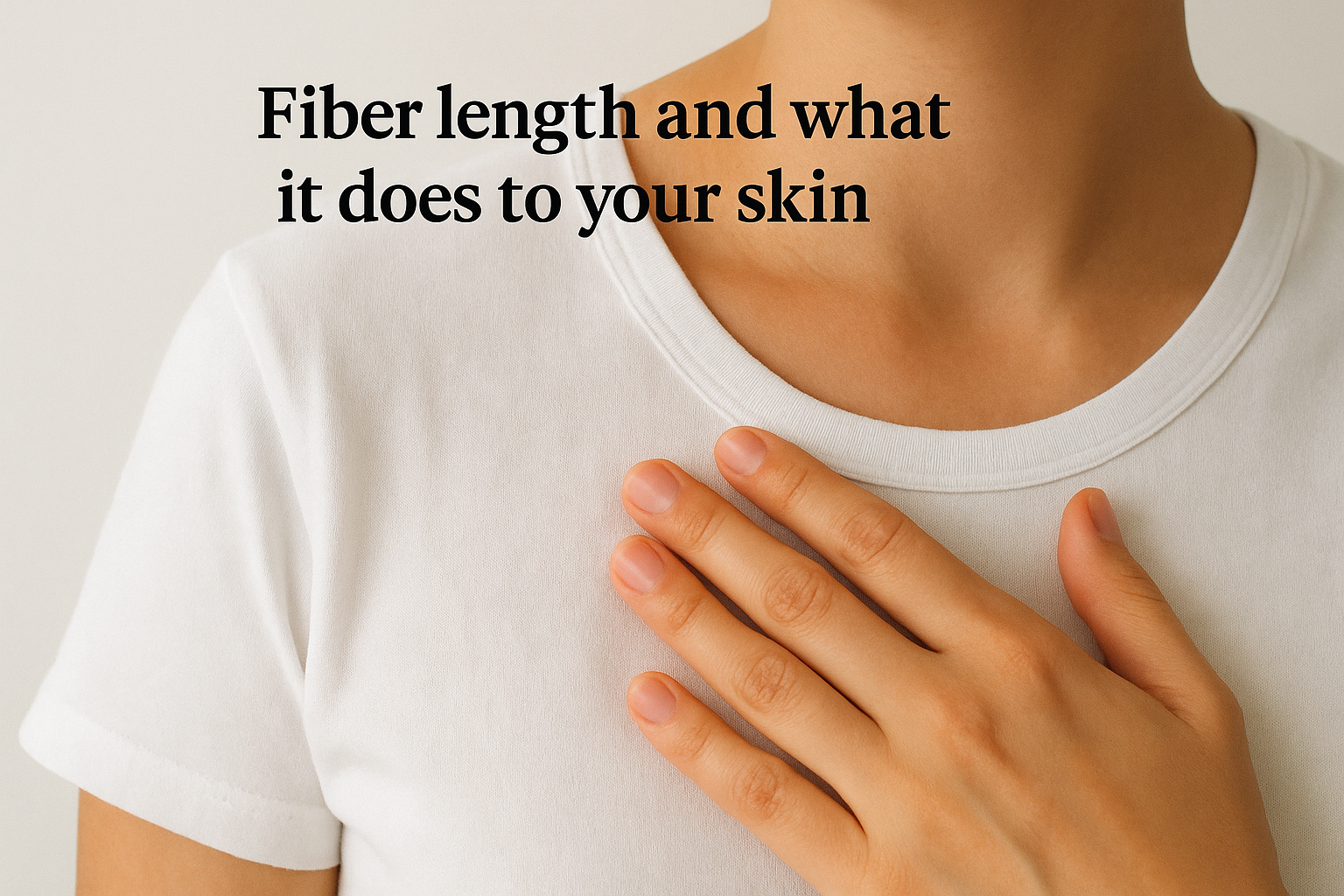
The longer the fiber, the smoother the yarn, and the smoother the yarn, the better the fabric feels directly against your skin.
Spinning method compounds this effect. Ring-spun yarn removes short, stray fibers and twists the remaining long fibers into a tighter, more uniform thread. Combed cotton goes one step further, combing out impurities before spinning. Both processes produce a denser, cleaner yarn that translates into softer fabric with fewer surface irregularities you can feel but rarely see.
Weight and how it shapes the wearing experience
Fabric weight, measured in grams per square meter (GSM), affects how a shirt moves with your body. Lightweight fabrics under 160 GSM tend to shift, cling, and go slightly translucent when stretched. A heavier fabric in the 280 to 300 GSM range carries enough mass to drape smoothly without pulling against your movements or revealing what's underneath.
Your skin also registers temperature differently based on weight. Denser fabrics buffer against sudden temperature changes more effectively, keeping the area between the fabric and your skin more consistent throughout the day, which reduces that restless, slightly-too-aware feeling that thin shirts create.
Fit and pattern work that elevates feel
Fabric alone doesn't explain why expensive t-shirts feel better throughout a full day of wear. How a shirt is cut and graded determines whether it moves with your body or constantly works against it. Even premium cotton will feel uncomfortable if the pattern underneath it was never designed for how human bodies actually move.
How cut affects freedom of movement
A well-cut tee accounts for the natural forward rotation of your shoulders. Most budget tees use a generic block pattern that holds your arms in a slightly unnatural position, which creates tension across your upper back whenever you reach forward. Premium patterns draft the sleeve angle to follow the way your arm hangs at rest, which removes that constant pull you feel when you lift your arms to type, reach, or carry something.
The side seams also matter more than most people realize. Cheap tees place seams straight down the body, which causes twisting after washing because the fabric bias shifts. A properly constructed tee aligns the seam with the natural fall of your torso, so the shirt stays oriented correctly wash after wash.
The best-fitting shirt is the one you stop thinking about within the first five minutes of wearing it.
How shoulder and sleeve placement change the fit
Your shoulder seam should sit at the exact edge of your shoulder, not hanging onto your upper arm or pulling toward your neck. When the seam lands in the wrong place, it creates a bunching effect at the top of your sleeve that you feel every time you move your arm. Correctly placed shoulder seams distribute the fabric tension evenly, which keeps the shirt sitting flat and still against your body.
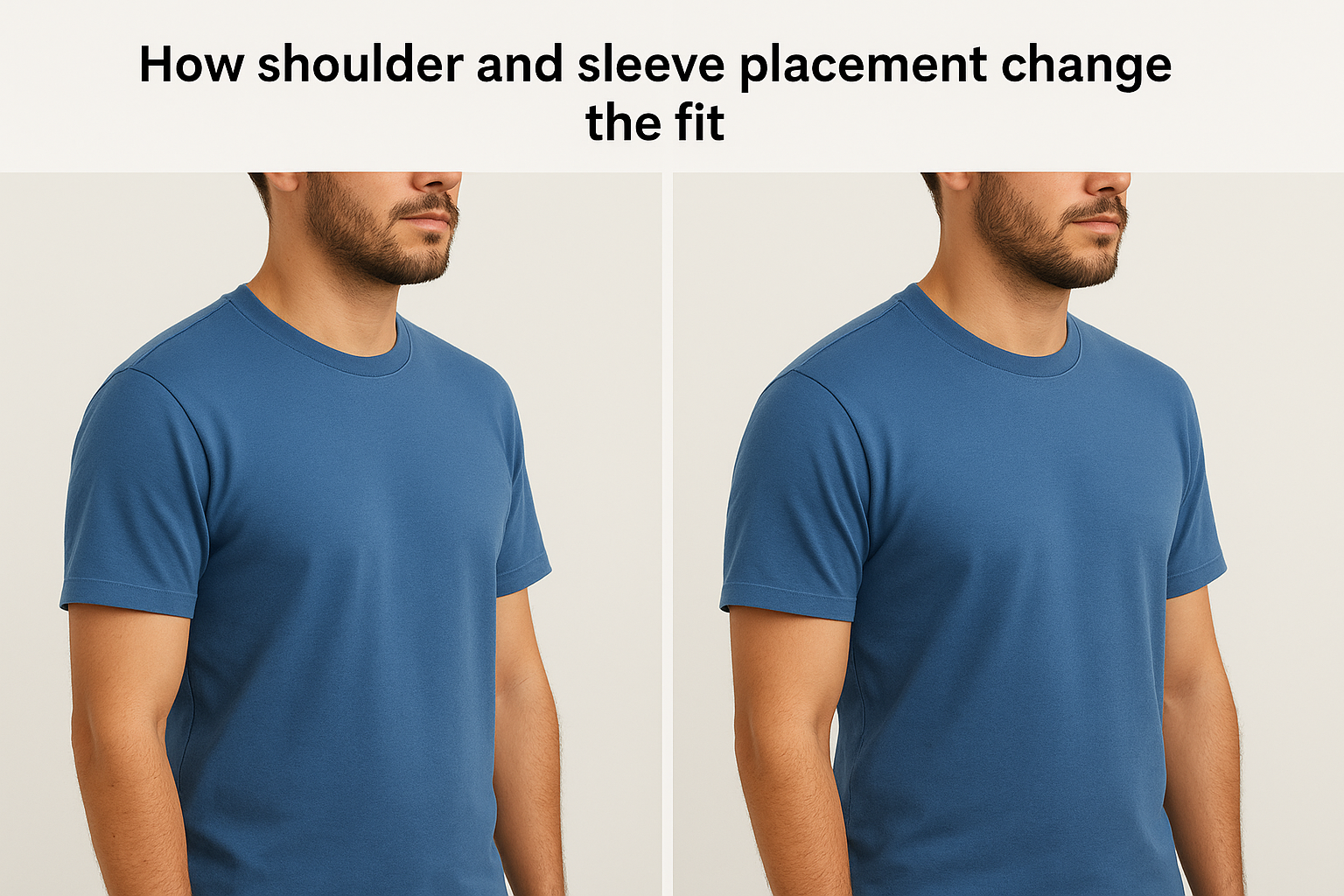
Sleeve width and length also affect how the shirt drapes when you're standing or sitting. A sleeve cut too wide collects fabric under your arm and creates bulk that shifts with every movement, adding to the low-level discomfort you carry through a full day.
Finishing details you notice every time you wear it
Finishing is where a manufacturer either commits to quality or cuts corners to save margin. Collar ribbing, hem stitching, and thread selection all affect how a shirt sits against your body on the tenth wear the same way they do on the first. These details rarely show up in product photos, but your body registers them every single time you put the shirt on.
Collar construction that stays put
The collar is the first thing that touches your skin and the first thing that fails on cheap tees. Budget collars use narrow ribbing with minimal reinforcement, which means they stretch out permanently after a few washes and start sitting unevenly against your neck. A well-constructed collar uses wider, denser ribbing and may include interior tape along the neckline seam to hold the original shape, keeping it flat and consistent wash after wash.
The collar tells you more about a shirt's long-term quality than almost anything else you can check before buying.
Your skin contacts the collar continuously throughout the day, so rough or uneven stitching at the neckline creates irritation that accumulates over hours. Flat, smooth seams at the neck simply disappear from your awareness, which is exactly what good finishing is supposed to do.
Hem and seam finishing that prevents breakdown
Single-needle stitching along the hem and side seams produces a flatter, more refined finish than the chain-stitch construction common in cheaper tees. Chain stitching unravels faster and creates a raised ridge along the seam that presses into your skin when you sit or move. A properly finished hem lies flat against your body and stays intact through hundreds of wash cycles without fraying or curling up at the edge.
Part of why expensive t-shirts feel better over months of ownership comes down to this compounding effect. Every finishing detail adds up: a collar that holds its shape, seams that lie flat, and hems that don't break down all produce a shirt you keep reaching for rather than one you tolerate.
How to tell if a pricey tee is actually better
Not every expensive t-shirt earns its price. Some premium-priced tees rely on brand recognition rather than genuine material or construction quality, which means you need a few simple checks before spending more than you should. Knowing exactly what to look for removes the guesswork and helps you make a confident decision before checkout.
What to check before you buy
Start with the fabric weight. Hold the shirt up and let it hang from your fingers: a well-made tee drapes with visible substance rather than flopping loosely or going translucent at the stretch points. Check the collar by pulling it gently and then releasing it. A quality collar snaps back to its original shape cleanly. If it deforms and stays that way in the store, it will do the same after three washes at home.
If a tee can't pass a simple collar and drape test in the store, the price tag alone doesn't justify the purchase.
Run your fingers along the interior seams, especially at the shoulder and hem. You should feel a flat, consistent stitch line rather than a raised ridge or uneven tension. Loose threads or fraying on a brand-new seam signal that the construction won't hold up once regular washing begins, regardless of how the shirt feels on the first try.
The label details that actually tell you something
Fiber content is the fastest honest signal available at the point of purchase. Look for Supima, Pima, or long-staple Egyptian cotton specifically named on the label. Generic "100% cotton" without a variety name typically means commodity-grade fiber, and this specific detail is a core part of why expensive t-shirts feel better when they name their source material rather than hiding behind a vague description.
GSM listed on the tag or product page is the second number worth checking. Anything in the 260 to 320 range signals a shirt built for durability and consistent drape rather than one designed to impress at first touch and disappoint after the first wash.
A simple way to upgrade your everyday tee
Understanding why expensive t-shirts feel better gives you a clear filter for every purchase going forward. You don't need a large wardrobe to experience the difference. You need fewer shirts made from better materials, cut with intention, and finished with enough care to last years rather than months. One well-built tee worn regularly outperforms a drawer full of forgettable ones in both comfort and long-term value.
Start with a single upgrade. Replace the tee you reach for most often with one that checks every box: long-staple cotton, a GSM above 260, a collar that holds its shape, and seams that lie flat against your body. That single swap changes your daily baseline, and once you've worn a shirt built this way, the difference becomes impossible to ignore. If you want a tee built exactly on these principles, explore the SÖMNAD relaxed tee and see what everyday essentials can actually feel like.